Many Albertans assume bad credit and no credit are basically the same thing when it comes to getting a car loan. They are not, and that misconception can cost you real money or cause you to give up on auto financing before you even start. Whether you are a newcomer to Canada, a young worker with no borrowing history, or someone who has had financial setbacks, the way lenders see your file is very different in each case. This guide breaks down exactly what separates these two profiles, how Alberta lenders actually make decisions, and what practical steps give you the best shot at approval.
Understanding bad credit and no credit: What’s the real difference?
Let’s start by breaking down the basics that lenders look for when you apply for an auto loan in Alberta.
Most people use “bad credit” and “no credit” interchangeably, but they describe completely different situations. Bad credit typically means a FICO score under 580 to 600, combined with a history of late payments, defaults, or high credit utilisation. No credit, on the other hand, means you simply have no borrowing history at all. You are a blank page rather than a page with red marks on it.
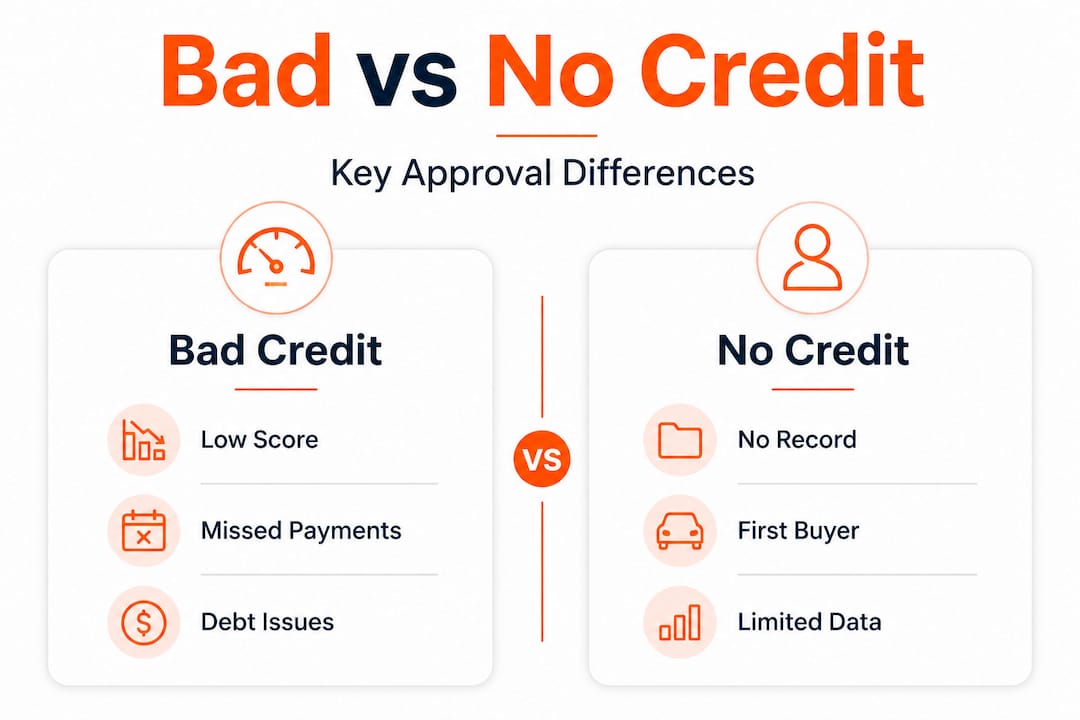
Lenders treat these profiles very differently. No credit is generally viewed more favourably than bad credit because it represents unknown risk rather than proven poor financial behaviour. Think of it this way: a landlord would rather rent to someone with no rental history than to someone who has been evicted twice.
There are also common bad credit car loan myths that lead borrowers to believe approval is impossible, when in reality the path forward is simply different depending on your profile.
Key traits lenders flag in each profile:
- Bad credit: Collections accounts, recent bankruptcies, consumer proposals, multiple hard inquiries, high debt-to-income ratio
- No credit: No credit cards, no prior debt, no utility accounts in your name, recent arrival to Canada
- Both profiles: May require a larger down payment or proof of stable income to offset perceived risk
Understanding which category you fall into is the first step. It shapes every decision from here on.
How approval works in Alberta: From credit score to your paycheque
Now that you know what each credit profile means, here’s what really drives approvals for auto loans in Alberta.
Here is something that surprises many borrowers: Alberta’s subprime lenders often care more about your paycheque than your credit score. Subprime lenders in Alberta approve based on income, employment stability of six or more months, debt-to-income ratio, and down payment amount rather than solely on credit score. There is no universal minimum score required.

This is genuinely different from how a major bank operates. A bank runs your score and stops there if the number is too low. A subprime lender runs the whole picture. If you earn $3,500 a month and have held your job for eight months, that tells a story that a credit score simply cannot.
The core approval criteria Alberta lenders weigh:
- Monthly income: Most lenders want to see verifiable income each month
- Employment length: Three to six months or more at your current job is the general benchmark
- Debt-to-income ratio (DTI): Your total monthly debt payments should ideally stay under 40% to 45% of your gross income
- Payment-to-income ratio (PTI): Your car payment alone should be no more than 15% to 20% of your gross monthly income
- Down payment: Even a modest amount of $500 to $1,000 signals commitment and lowers lender risk
- Residency stability: A consistent address history, ideally six months or more at your current home
The pre-approval process itself is fast. Alberta’s streamlined online process takes two to three minutes for a soft-pull pre-approval that does not affect your credit score, followed by proof of income and residence, with approvals arriving in minutes to 48 hours through dealership subprime networks.
What if you’re self-employed or just arrived?
Not all applicants fit the main mould. Here’s what to know if your situation is outside the norm, and how to start rebuilding today.
Some of the most common edge cases in Alberta include people who are self-employed, those who have gone through bankruptcy or a consumer proposal, and newcomers to Canada with no domestic credit history. Each situation has a workable path forward.
Bankruptcy, consumer proposals, newcomers, and self-employed applicants can all be approved with proper income proof. Zero-down auto financing is possible with strong income, trade-in equity, or a combination of both, though rates will be higher and terms may be shorter.
Here is how to approach each situation:
- Self-employed: Provide six months of bank statements showing consistent deposits, your most recent Notice of Assessment from the CRA, and any business registration documents
- Bankruptcy or consumer proposal: Wait until you are discharged, then apply with a strong income and a modest down payment. Many lenders specialise in post-bankruptcy car financing
- Newcomer to Canada: Bring your employment letter, bank statement and proof of address
- Seasonal worker: Document your seasonal income pattern with T4 slips from the past two years and a letter from your employer confirming ongoing work
Once approved, the rebuilding process is straightforward. On-time payments rebuild your score by 50 to 100 points within 12 to 18 months.
Steps to rebuild your credit effectively with a car loan:
- Set up automatic payments so you never miss a due date
- Keep your other debts low and avoid opening new credit accounts in the first six months
The Alberta advantage: Why lenders here say yes when banks say no
There is something genuinely different about how auto financing works in Alberta compared to the rest of Canada, and it is worth understanding why.
Alberta’s economy is built around resource industries, particularly oil and gas, where income can be high but employment patterns are irregular. Alberta’s oil and gas volatility has shaped a lending culture that favours flexible risk assessment, with streamlined online applications designed to be judgment-free and accessible to newcomers and seasonal workers alike.
This matters because it means the old rules from traditional banking do not always apply here. A major bank in Toronto might decline you based on a score alone. An Alberta subprime lender looks at your last six pay stubs and asks a different question: can this person afford this payment?
We have seen this play out repeatedly with clients who were turned down by their bank, applied through a subprime network, and drove away in a vehicle within 24-48 hours. The misconceptions in auto loan approvals that keep people from applying are often based on experiences with traditional banks, not with the flexible lenders who actually serve this market.
Our perspective is this: if you have income and stability, your credit score is a starting point for the conversation, not the end of it. Alberta’s lending environment was built for exactly the kind of borrower that banks overlook.
Ready to apply? See your options and start your journey
If you have read this far, you already know more about Alberta auto loan approvals than most borrowers do when they walk into a dealership. That knowledge is your advantage.
At Summit Auto Loans, we work with Albertans across every credit profile, from no history at all to past bankruptcies, and our process is built to be fast, transparent, and completely judgment-free. You can estimate your car, SUV or truck loan before you apply, and start your fast approval process in seconds with no impact to your credit score. Whether you are in Edmonton, Calgary, or anywhere in between, a vehicle and a clearer financial future are closer than you think.