Many Albertans assume that a perfect credit score is the golden ticket to getting approved for a car loan. That belief stops a lot of people from even trying. The truth is that lenders evaluate multiple factors when deciding whether to approve your application, and credit is just one piece of a much larger picture. Understanding exactly what lenders look for gives you a real advantage, whether you’re rebuilding your finances, new to Canada, or simply shopping for your first vehicle.
Key Takeaways
| Point | Details |
|---|---|
| Lenders assess multiple factors | Eligibility is based on credit, income, employment history, and required documents. |
| Bad credit options exist | Subprime lenders focus on income stability and DTI, opening doors for a range of applicants. |
| Debt-to-income ratio is crucial | Keep your total debts below 40% of gross income and car payments within 15% for best approval chances. |
| Prepare your application | Gather proof of income, insurance, and ensure your vehicle meets eligibility requirements before applying. |
| Local expertise can help | Specialised auto loan providers in Alberta guide you through eligibility and streamline the process. |
What lenders look for in auto loan eligibility
Now that you’re aware that credit isn’t the only consideration, let’s break down exactly what Alberta lenders evaluate for auto loan eligibility.

When you apply for an auto loan in Alberta, lenders are essentially asking one core question: can this person reliably repay what they borrow? To answer that, they look at several connected factors rather than just your credit score alone. As ATB Financial confirms, lenders assess creditworthiness, income, and employment history to determine auto loan eligibility in Alberta.
Here are the primary criteria lenders typically review:
- Credit score and credit history: Your score signals how you’ve managed debt in the past. A higher score can unlock better interest rates, but it is not an automatic disqualifier if it’s low.
- Employment history and stability: Lenders want to see that you’ve held a job consistently. A full-time position of at least three months with the same employer is often preferred.
- Gross monthly income: This tells the lender how much money comes in before taxes, helping them judge how much you can afford to repay.
- Debt obligations: Existing debit, credit card balances, and other monthly payments are factored against your income.
- Valid driver’s licence: Without one, no lender will approve you for a vehicle loan.
- Proof of insurance: Many lenders require you to have insurance in place, with the lender listed as a loss payable party.
- Bill of sale: This document confirms the vehicle purchase details and is required to finalise your auto financing.
To make the documentation side easier, it helps to consult an auto loan requirements checklist before you start your application. If your credit profile has some bumps, focusing on the other factors listed above can go a long way toward improving your eligibility. You can also take proactive steps to build your credit before applying, which strengthens your overall application significantly.
| Document | Purpose |
|---|---|
| Valid driver’s licence | Confirms identity and legal driving status |
| Pay stubs or tax returns | Proves income and employment |
| Bank statements | Shows financial behaviour and cash flow |
| Proof of insurance | Required before vehicle registration |
| Bill of sale | Confirms purchase agreement details |
The role of credit scores and alternative criteria
Beyond basic requirements, the way different lenders assess credit and other criteria can change your eligibility prospects considerably.
Traditional banks and credit unions generally require a credit score of 660 or higher before they’ll approve a standard auto loan. Below that threshold, your options with conventional institutions get limited quickly. However, subprime lenders and many dealerships take a more flexible approach. They look more closely at your income stability and your debt-to-income ratio (DTI, meaning how much of your income is already committed to debt payments) rather than relying heavily on your credit score alone. This approach opens access for newcomers to Canada, people rebuilding credit, and those receiving social assistance.
| Lender type | Credit score focus | Income and DTI focus | Best for |
|---|---|---|---|
| Traditional banks | High (660+) | Moderate | Established credit profiles |
| Credit unions | Moderate (620+) | Moderate to high | Members with local ties |
| Subprime lenders | Low or none | Very high | Bad credit or no credit applicants |
| Dealership financing | Flexible | High | Various credit backgrounds |
One important detail many applicants miss: there is a difference between pre-qualification and a full application. Pre-qualification uses a soft credit pull, which means it does not affect your credit score at all. A full application, however, triggers a hard credit check, which can temporarily lower your score by a few points. Avoid submitting multiple full applications at once, as each hard pull adds up.
Something worth knowing: Vehicle age and mileage can also affect your eligibility, particularly with subprime lenders. Older vehicles or those with very high kilometres may be excluded from certain auto loan programmes due to vehicle eligibility restrictions. Always confirm these limits before selecting a vehicle.
Pro Tip: If you’re unsure about your credit standing, learn how to qualify with bad credit before you apply. Understanding the difference between bad credit vs no credit can also help you target the right lender from the start.
Debt-to-income ratios and income thresholds
As we shift from credit and alternative paths, let’s explore how your income and debt levels play a critical role in the approval process.
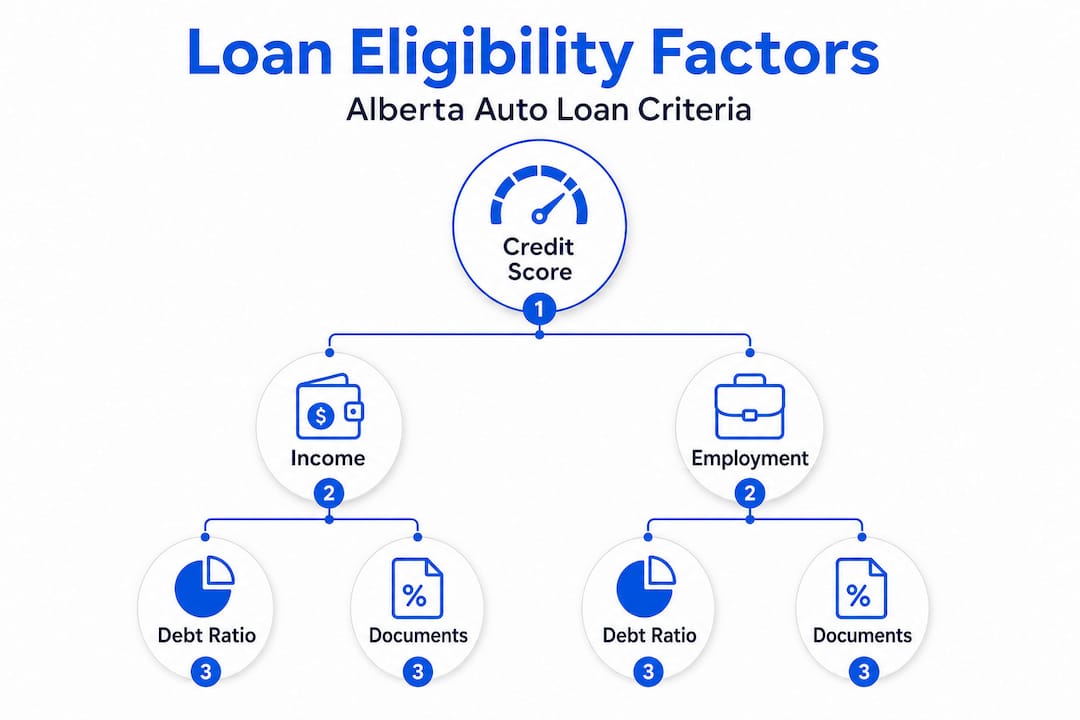
Your DTI ratio is one of the most practical numbers a lender looks at. It compares your total monthly debt obligations to your gross monthly income. A lower DTI tells the lender you have breathing room in your budget, which makes you a lower-risk borrower. According to auto loan income guidelines, a DTI below 36 to 40% is preferred, and your total debts including the new car payment should not exceed 40% of your gross income. Ideally, your car payment alone should sit between 10 and 15% of your gross monthly income.
Here is how to calculate your own DTI before you apply:
- Add up all monthly debt payments. Include rent or mortgage, credit cards, student debt, and any other recurring obligations.
- Identify your gross monthly income. This is your income before taxes and deductions. Use the amount from your pay stubs or tax returns.
- Divide total monthly debts by gross income. Then multiply by 100 to get your DTI percentage.
- Factor in your estimated car payment. Use an online lauto oan calculator to estimate your monthly payment based on a realistic vehicle price.
- Check whether the new total stays below 40%. If it pushes past that threshold, you may need to consider a less expensive vehicle or pay down some existing debt first.
For more detailed DTI ratio guidance, it helps to read through the key eligibility markers for Alberta specifically. And if you have broader questions about auto financing, reviewing essential questions before car financing can save you time and prevent surprises down the road.
Key statistic: A car payment representing more than 15% of your gross monthly income significantly increases your risk of vehicle loan default, which is why lenders use this ratio as a practical benchmark for affordability.
How to boost your eligibility and prepare your application
Once you understand the criteria, it’s time to focus on specific actions that can help you qualify and reduce stress during your auto loan journey.
Preparation is where most applicants gain a real advantage. Lenders respond well to organised, complete applications because they signal reliability. As ATB Financial notes, lenders assess creditworthiness, income, and employment history to determine eligibility, so making sure all three are well-documented is your best starting point.
Here are key actions to strengthen your application:
- Gather all required documents early. Compile your pay stubs, most recent tax returns, bank statements, proof of insurance, and driver’s licence well before applying.
- Review your credit report. Obtain a free copy from Equifax or TransUnion and dispute any errors before they affect your application.
- Pay down high-interest debt first. Reducing credit card balances lowers your DTI and improves your credit utilisation ratio at the same time.
- Choose an eligible vehicle. Confirm that the car you’re eyeing meets the lender’s age and mileage requirements. Vehicles under 10 years old with reasonable kilometres are typically the safest choices.
- Consider a co-signer. If your credit or income falls short, a co-signer with a stronger profile can significantly improve your approval odds.
Pro Tip: Even small improvements to your credit score, like paying a bill on time for three consecutive months, can shift you from one credit tier to the next and meaningfully change your interest rate offer.
The overlooked truths about auto loan eligibility in Alberta
Here is something we have seen time and time again working in Alberta auto lending: most applicants focus almost entirely on their credit score and overlook the factors that lenders actually weigh most heavily in borderline cases. Income stability and a low DTI will often outweigh a middling credit score. A borrower with a 620 score, steady full-time employment, and a DTI of 28% is a stronger candidate than someone with a 680 score who is carrying heavy debt.
Subprime lenders in Alberta actively serve people who fall outside traditional lending boxes. Newcomers to Canada, people who have recently gone through a financial hardship, and those receiving assistance programmes are all candidates that these lenders regularly work with. The key difference is documentation. These lenders need to see clear evidence of income because credit history is thin or damaged. That makes income proof the single most critical document in your package.
The most common mistake we see is applicants arriving with incomplete paperwork. Missing a single pay stub or not having your insurance documentation ready can delay your approval by days. Coming to the table with everything organised signals to the lender that you are serious and prepared. For a thorough look at what truly affects approval, our broader eligibility insights break down what matters at each stage of the process.
The other overlooked reality is that many Albertans qualify for more than they expect. Rushing through an application without calculating your DTI first, or without shopping around, often results in less favourable car loan terms. Slow down, prepare well, and you are likely to find the process much more straightforward than you anticipated.
Find accessible auto loan solutions in Alberta
Armed with actionable insights, here’s how you can take the next step with a provider that understands Alberta’s unique lending landscape. At Summit Auto Loans, we specialise in helping Albertans with all types of credit backgrounds find auto financing that works for their real lives. Whether you’re just starting to understand your eligibility or you’re ready to apply today, our tools make the process clear and manageable.
Frequently asked questions
What documents do I need to apply for an auto loan in Alberta?
You must provide a valid driver’s licence, proof of income such as pay stubs or tax returns, employment confirmation, proof of insurance with the lender listed as loss payable, and a bill of sale confirming the purchase details.
Can I get an auto loan with bad credit or no credit in Alberta?
Yes. Subprime lenders and many dealerships focus more on income stability and DTI than high credit scores, meaning borrowers with bad or no credit can qualify through these channels.
How much income do I need to qualify for a car loan?
Your total monthly debts including the car payment should not exceed 40% of your gross income, with your car payment ideally sitting between 10 and 15% of your gross monthly income.
Will applying for an auto loan impact my credit score?
Pre-qualification uses a soft pull and does not affect your score, but submitting a full application triggers a hard check that can temporarily lower your score by a few points.