
Believing the wrong thing about auto financing can cost you thousands of dollars. That is not an exaggeration. Auto loan myths explained clearly and honestly can mean the difference between a loan that works for your budget and one that leaves you financially stuck for years. From fears about credit damage when you shop around, to the illusion that longer loans save you money, these common auto loan misconceptions steer buyers in the wrong direction before they ever sign a contract. This article breaks down the top auto loan myths, gives you the real facts, and shows you how to use that knowledge to make smarter financing decisions.
Myth #1: Shopping around for a loan wrecks your credit
This is one of the most persistent car loan myths debunked by the way credit scoring actually works. Many buyers avoid comparing loan offers because they believe every inquiry leaves a damaging mark on their credit file. The truth is more reassuring.
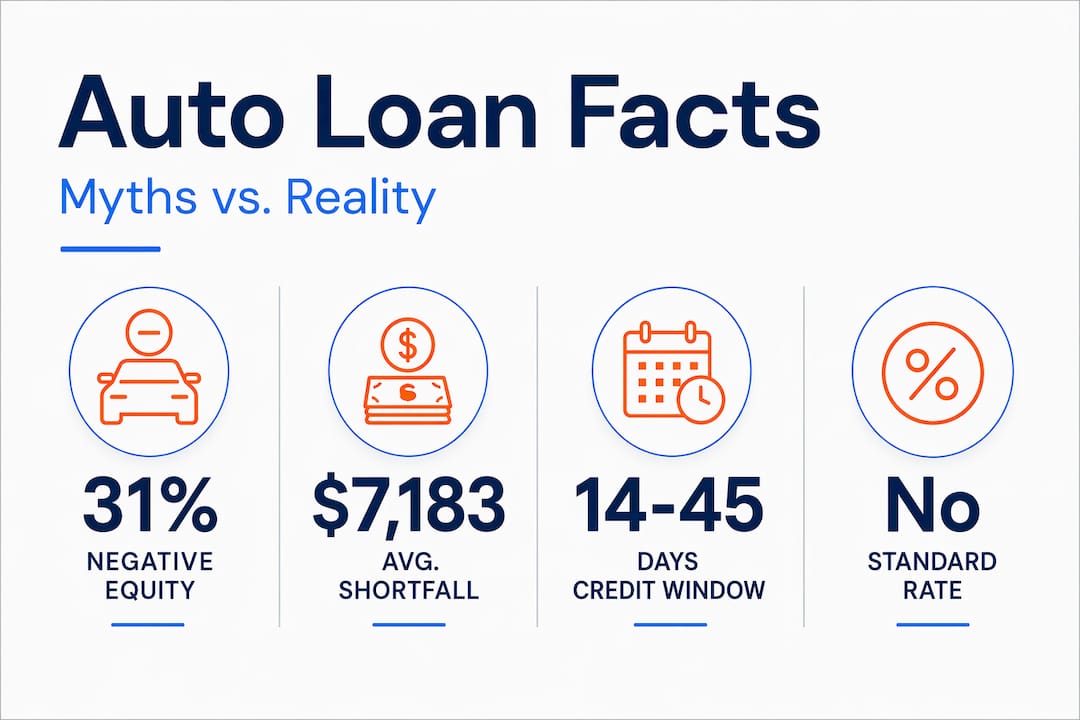
Credit scoring models are built to encourage rate shopping. Multiple inquiries consolidated within a 14 to 45-day window are typically treated as a single inquiry for scoring purposes. That means you can gather several quotes without multiplying the credit impact.
It helps to understand the difference between a soft check and a hard check. A soft check, often used for pre-qualification, does not affect your score at all. A hard check does, but only modestly, and only temporarily. The CFPB recommends rate shopping as a way to find better loan terms without meaningful score damage, as long as you time it correctly.
The mistake buyers make is spreading applications out over several months. Spread-out applications lose the protection of inquiry consolidation entirely, which is where the real credit damage comes from.
- Gather all your loan quotes within a two-week window to stay inside the consolidation period
- Pre-qualification soft checks carry zero score risk
- Hard inquiries have only a small and short-term impact on your file
- Spacing applications out over weeks or months is what genuinely causes harm
Pro Tip: Book all your loan quote requests in the same week. That simple bit of timing keeps your credit file clean while still letting you compare your options.
Myth #2: A longer loan term always saves you money
The appeal is obvious. A 72-month loan produces a noticeably smaller monthly payment than a 48-month loan on the same vehicle. But loan term length is about balancing monthly payment size with total loan cost and how quickly you build equity. It is not simply about picking the lowest payment.
Auto loan interest is front-loaded, meaning more of your early payments go toward interest than principal. On a longer term, this effect is amplified. You are paying more in total, and building ownership more slowly.
The table below illustrates how principal payoff compares after three years on a 72-month loan at two different annual rates.
| Loan term | Rate (APR) | Principal paid after 3 years |
|---|---|---|
| 72 months | 8% | ~44% of principal |
| 72 months | 18% | ~37% of principal |
As you can see, at higher financing costs, you still owe the vast majority of your loan balance three years in. Meanwhile, the vehicle itself has depreciated significantly, often by 30 to 40 percent in the first three years. That gap between what you owe and what the car is worth is where financial trouble begins.
For context, read best practices for auto loans in Canada to understand how loan structures affect your total cost over time.
Pro Tip: Ask yourself how long you realistically plan to keep the vehicle. If you see yourself trading it in within three or four years, a shorter loan term protects you from owing more than the car is worth at trade-in time.
Myth #3: Negative equity is rare and not a big deal
Negative equity, also called being underwater, means you owe more on your loan than the vehicle is currently worth. Many buyers assume this only happens to people who made a poor financial decision. The data tells a different story.

In Q1 2026, 30.9% of new-vehicle trade-ins carried negative equity, with an average underwater amount of $7,183. That is close to one in three trade-ins. And among that group, 26% had rolled over more than $10,000 in unpaid debt into their next loan.
This is how the debt cycle works: you trade in your vehicle before the loan is paid off, the remaining balance gets added to your new loan, and suddenly you are starting your next financing agreement already in the red. Your monthly payment climbs, your new loan is larger than the vehicle justifies, and negative equity compounds with each transaction.
Vehicle depreciation is the engine driving this problem. Cars lose value rapidly in their early years, and depreciation outpaces loan payoff when loan terms are long and down payments are small.
Here is what you can do to reduce your exposure:
- Choose a vehicle priced within your actual budget, not the maximum you can qualify for
- Opt for a shorter loan term where financially possible
- Make a meaningful down payment to reduce the initial gap between loan balance and vehicle value
- Avoid rolling significant negative equity into a new loan. If possible, pay it down separately before trading in
You can also explore risks of financing rebuilt vehicles, where negative equity risks are compounded by depreciation unique to that vehicle category.
Myth #4: Everyone gets the same standard loan rate
There is no universal rate that all borrowers receive. Published national averages are reference points, not guarantees. As of 2026, the average rate for a 60-month new-car loan sits around 7.40% APR, but what you personally receive will depend on your individual financial profile, the vehicle you choose, the loan term you select, and the lender you work with.
The table below highlights why the “one standard rate” idea does not hold up.
| Factor | How it affects your loan offer |
|---|---|
| Vehicle type (new vs used) | New cars typically receive lower rates than used vehicles |
| Loan term length | Shorter terms often carry different pricing than longer ones |
| Buyer financial profile | Lenders assess income, employment, and credit history individually |
| Lender criteria | Each lender sets its own policies and approval standards |
This is precisely why pre-approval matters. Getting pre-approved before you visit a dealership gives you a baseline, real number to work with rather than assuming you will land on any published average. Understanding why your credit profile matters for auto loans in Canada helps you set realistic expectations when evaluating the offers you receive.
Putting it all into practise
Knowing the auto financing truths behind these myths is only useful if you apply them. Here is a straightforward approach to carrying these insights into your next loan search.
- Time your applications. Gather all your loan quotes within a 14-day window to benefit from inquiry consolidation and protect your credit file.
- Choose your term deliberately. Match the loan length to how long you plan to keep the vehicle. A shorter term costs more monthly but builds equity faster and reduces financial risk.
- Assess your equity position before trading in. If you are underwater on your current loan, calculate the gap before adding it to a new one. Rolling over a large balance compounds your financial exposure significantly.
- Treat published rates as benchmarks, not guarantees. Your actual offer will reflect your individual profile. Focus on getting pre-approved with a lender who takes your full picture into account.
- Work with a lender who explains things clearly. The right financing partner will walk you through every component of your loan so there are no surprises after you sign.
My honest take on auto loan myths
I have seen how much damage a single misconception can do. Buyers who were afraid to shop around because of credit fears ended up accepting the first offer they received, often a much worse deal than they could have negotiated. That fear cost them real money every month for years.
What strikes me most about debunking auto loan myths is how consistent the pattern is: the myths almost always push buyers toward worse decisions. Avoiding rate shopping, choosing the longest term to reduce monthly payments, ignoring negative equity when trading in. Each of these feels like the safe or easy choice in the moment, and each one tends to increase total cost or financial risk.
The negative equity situation is the one I find most frustrating to watch. Rolling over $7,000 or $10,000 of unpaid debt into a new loan feels manageable when it is buried in a monthly payment. But it starts your next ownership experience from a hole you did not dig on that vehicle. The mindset shift I would encourage is to view your loan as a financial structure you are building, not just a monthly number to manage.
Work with a lender who is willing to explain the trade-offs honestly. That transparency is worth more than a slightly lower payment figure on paper.
— Harvest
See how Summit Auto Loans makes financing clearer
If debunking auto loan myths has you thinking more carefully about your next vehicle purchase, Summit Auto Loans is ready to help you put that knowledge to work. Summit Auto Loans serves Albertans with all kinds of credit backgrounds and focuses on making the financing process transparent, personal, and free of the confusion that myths create.
You can use the loan payment calculator to model different term lengths and see exactly how your payments and total cost shift. When you are ready to move forward, the online approval process is fast and straightforward, with pre-approval available in seconds. Understand how the process works from start to finish before you commit to anything. Summit Auto Loans exists to give you clear answers and real financing options, not more confusion.
FAQ
Does shopping for auto loans hurt your credit score?
Not significantly, provided you keep all your applications within a 14 to 45-day window. Credit scoring models consolidate those inquiries into one, so rate shopping done right carries minimal credit impact.
Are longer auto loans always a better deal?
No. Longer loan terms lower your monthly payment but increase the total amount you pay over the life of the loan and slow down the rate at which you build equity in the vehicle, raising the risk of being underwater.
How common is negative equity on car trade-ins?
Very common. In Q1 2026, nearly 31% of trade-ins involved negative equity, with an average shortfall of over $7,000, making it a widespread risk rather than an uncommon scenario.
Is there one standard auto loan rate for all buyers?
No. Published averages like the national 60-month new-car rate are reference points, not guaranteed offers. Your actual rate depends on your financial profile, the vehicle, the term length, and the lender you choose.
What is the safest way to avoid the negative equity trap?
Choose a vehicle priced within your budget, make a reasonable down payment, and select a loan term that aligns with how long you plan to keep the vehicle. Avoid rolling significant unpaid balances into your next loan.


