
Most Canadian car buyers fixate on one number: the monthly payment. It feels manageable, concrete, and easy to compare against your paycheque. But that single figure often hides the real cost of borrowing, and that gap between perceived and actual affordability is where financial regret quietly grows. Understanding why use a car loan calculator matters is not about doing more homework. It is about having the right information before you sign anything. This guide breaks down exactly how these tools work, what they reveal, and why no Canadian buyer should shop without one.
Why use a car loan calculator before you shop
A car loan calculator, sometimes called an auto loan estimator, is a free digital tool that models what your auto financing will look like before you ever speak to a lender. You enter a few key figures and the calculator does the rest.
The core inputs are straightforward:
- Car loan amount: The total amount you plan to finance after your down payment
- Down payment: What you are contributing upfront, which reduces what you borrow
- Vehicle loan term: The repayment period, typically 36, 48, 60, or 72 months
- Fees and taxes: Any government taxes or administrative charges rolled into the auto loan
The outputs are where the real value appears. NerdWallet’s calculator shows monthly payment, total interest paid, and a full amortisation schedule, which breaks down how much of each payment goes toward the principal versus the cost of borrowing. Early in an auto loan term, a surprising portion of every payment covers borrowing costs rather than reducing what you owe.
One common mistake is entering only the vehicle sticker price. Accurate calculator use requires inputting the full financed amount, including taxes, documentation fees, and any extras rolled into the car loan. Miss those, and your monthly estimate will be lower than your actual payment.

Pro Tip: Before running your numbers, add up the vehicle price plus all applicable provincial taxes and fees. Use that total, minus your down payment, as your financed amount. Your estimate will be far more reliable.
The budgeting benefits you cannot afford to skip
This is where auto loan calculators earn their keep. The monthly payment alone tells you almost nothing useful. What matters is whether the full auto loan fits within your financial life without creating strain.
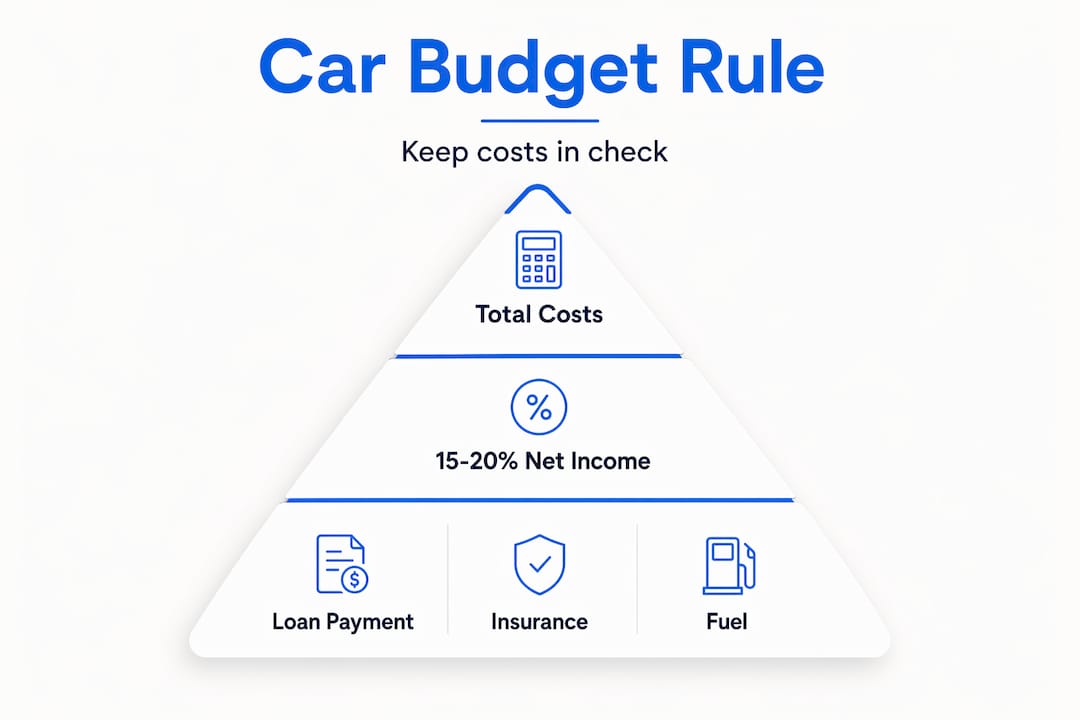
A practical rule of thumb: total vehicle costs, including your vehicle loan payment, insurance, and fuel, should stay below 15 to 20 per cent of your net monthly income. The auto loan payment alone should sit under 10 per cent of your gross income. A calculator lets you test whether you are inside or outside those limits before committing.
The comparison below shows how dramatically auto loan term length affects both monthly affordability and total cost, based on a $30,000 financed amount.
| Auto loan term | Approximate monthly payment | Approximate total interest paid |
|---|---|---|
| 48 months | Higher | Lowest overall |
| 60 months | Moderate | Moderate overall |
| 72 months | Lowest | Highest overall |
The pattern is consistent and striking. Longer car loan terms lower your monthly payment but increase the total interest you pay, sometimes by thousands of dollars. A buyer who stretches to 72 months to make the payment feel comfortable may end up paying substantially more for the same vehicle than someone who chose a 48-month term.
Modelling at least three term lengths before making any decisions gives you a clear picture of where the tradeoffs sit. You might find that stretching your down payment by a few hundred dollars dramatically changes your total cost. You would never know without running the numbers.
Pro Tip: Run your calculator with two down payment scenarios: what you originally planned and a version where you add $1,000 to $2,000 more. The total interest savings often make that extra upfront contribution worth prioritising.
Using calculator results as a negotiation tool
Walking into a dealership without a number in your head is one of the most costly things a buyer can do. Salespeople are skilled at reframing conversations around monthly payments, and knowing your monthly ceiling beforehand is your best protection against that tactic.
Here is what calculator-prepared buyers do differently:
- They arrive knowing the maximum monthly payment that fits their budget
- They focus negotiations on total vehicle price, not just the monthly figure
- They recognise when an extended term is being offered to make a vehicle appear affordable
- They use their pre-calculated numbers as anchors rather than reacting to dealer proposals
Dealer tactics that focus borrowers on monthly payment anchors are a well-documented sales strategy. When a salesperson says “we can get you into this vehicle for $450 a month,” they may be proposing an 84-month term that costs you far more overall. Your calculator results cut through that framing immediately.
The key is to treat your calculator output as a financial baseline, not a guarantee. Present those numbers as your informed starting point in any auto financing conversation. Calculator results used as negotiation targets anchor discussions and reduce the risk of being guided into terms that benefit the lender more than you.
Pro Tip: Visit Summit Auto Loans’ auto loan calculator before you start shopping. Use those results as your financial baseline when discussing auto financing options.
Common myths that calculators put to rest
A lot of costly car financing decisions come from beliefs that feel logical but do not hold up under scrutiny. A few minutes with a calculator dismantles most of them quickly.
Myth one: The lowest monthly payment is always the best deal.
This is probably the most financially damaging belief in car buying. The lowest monthly payment almost always comes from the longest vehicle loan term, which generates the most total interest. Consider this: at 12 per cent on a $12,000 vehicle loan over five years, total interest approaches $4,000. At a lower rate over a shorter term, that same car loan might cost $1,250 in interest. The monthly payment difference might be $60. The total cost difference is nearly $2,750.
Myth two: The car loan amount equals the vehicle price.
Taxes, fees, and any optional add-ons rolled into the vehicle loan push the financed principal well above the sticker price. Buyers who underestimate the financed principal consistently find that their real payments exceed what they expected.
“The real danger in car financing is not the monthly payment you agree to. It is the total amount you pay before the car loan is settled. A calculator shows you both numbers side by side, so you can make a real decision instead of a comfortable-sounding one.”
Misconceptions like these are not rare. They are the norm for buyers who rely on dealer presentations rather than doing their own modelling. You can read more about auto loan terminology explained to get comfortable with the language before you walk into any car financing conversation.
Get approved with confidence at Summit Auto Loans
Understanding your numbers is the first step. Getting approved on terms that work for your life is the second. At Summit Auto Loans, the process is designed for Canadians across all credit backgrounds, whether your credit history is strong, limited, or complicated. There are no lengthy delays or confusing back-and-forth. You can calculate your car loan directly on the site to model your payment scenarios, then move straight to the approval process. When you are ready, get approved with Summit in seconds and let a dedicated specialist guide you toward a vehicle and auto financing plan that actually fits your budget. Transparency and accessibility are built into every step.
FAQ
What does a car loan calculator actually show you?
A car loan calculator shows your estimated monthly payment, total interest paid over the vehicle loan term, and an amortisation schedule. These outputs together reveal the true cost of borrowing, not just what you owe each month.
Why is the vehicle loan term so important to calculate?
Auto loan term length directly affects both your monthly payment and total interest. Longer terms lower monthly payments but increase overall cost significantly, so modelling multiple terms helps you find the right balance.
Do I need to include taxes and fees in the calculator?
Yes. For accurate results, you should input the full financed amount after your down payment, including all taxes and applicable fees. Entering only the vehicle price consistently underestimates your real payment.
How does a calculator help with dealership negotiations?
Calculator results give you a financial baseline before any dealership conversation. Knowing your maximum affordable payment and total cost ceiling prevents you from being guided into extended terms that cost more overall.
Can a car loan calculator help if I have less-than-perfect credit?
Absolutely. A calculator helps you understand what car loan amounts and terms are realistic for your budget regardless of your credit situation. Pairing that knowledge with a lender like Summit Auto Loans, which supports all credit backgrounds, puts you in a strong position to get approved.


